

by Tom Keer
While steel was the first non-toxic shot to appear during the 1991 waterfowl season, it has more recently taken a backseat to other performance metals. There are a lot of other heavy metals from which to choose, with tungsten, copper, bismuth, nickel, and blends that feature a pinch of this and a dash of that as part of the options. But steel has been foundational for many of us because it’s affordable. All you have to do to realize a savings is to hunt and shoot a lot. Improving performance in an affordable shell is a lofty goal.
To create their Fasteel 2.0, Kent identified three strategic points they wanted to improve. First, each of the shell’s components needed quality improvements. Second, the new shell needed to deliver a load that was faster and more lethal than the original. And third, both couldn’t cause the price to rachet skyward. To get there, product developers started with improvements.
The smooth cycling of shells significantly contributes to a successful duck hunt, and Kent looked to improve the quality of their hulls. With improved ejection as a goal, Kent shifted away from materials that would pit, then searched for a non-brass base. They went with nickel, an affordable and durable option that doesn’t corrode easily and ejects smoothly. Next, Kent went with a higher-density polymer hull that added additional hull strength that reduced bending during the cycling process, and ejection efficiency improved. Lastly, the base wad was upgraded and resized to accommodate the tighter chambers of many imported semi-automatic shotguns.
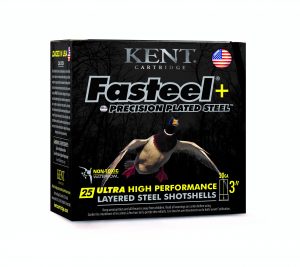 Another of Kent’s performance goals for Fasteel 2.0 was to see how far they could push on the payload and velocity combination before there was a falloff in pattern performance. Three factors were included in the testing process: maximizing pattern density, improving pattern uniformity and how evenly spread it is in a 30-inch circle, and maintaining the total foot pounds of energy in all pellets in the pattern. Kent engineers used a duplex combination of equal amounts of larger and smaller sized shot. Tightening the pattern was the goal, and the result of those two sizes was that the smaller shot drafts behind the larger shot. More pellets arrive on target at the same time, and impact is more lethal. The smaller shot increased the number of pellets per load. In the 12-gauge, a three-inch shell, a 1¼ ounce load of 2 x 4 shot, delivers 198 pellets. Compare that number to a comparable load of single-sized No. 2 pellets and you’ll see that Fasteel 2.0 delivers a 27 percent increase in pellets.
To increase speed, Kent created a custom blend of double-base powders. That blend would offer more consistent pressures, which improved downrange speeds. The 12-gauge Fasteel 2.0 loads run at 1450 feet per second, which is an 18 percent increase in speed from the original load’s 1225 feet per second. In addition, those powders burn more cleanly and that cleanliness contributes to improved semi-automatic cycling. They also ignite in a wide range of temperatures and weather conditions that cover what might be experienced on hot opening days and frigid late season wrap-ups. Ladder in a sealed, CX 2000 primer and you’ve got one of the most reliable ignition systems in the shotshell business.
For more information visit www.kentcartridge.com.